Encyclopaedia Index
[Section 2 of the PHOENICS Encyclopaedia article on multi-phase flow.
Click here for the start of the article]
Method (1): Two inter-penetrating continua: IPSA
This method uses the IPSA (Inter-Phase-Slip Algorithm), which
entails solving the full Navier-Stokes equations for each phase.
In most circumstances, the two phases are taken as having the same
pressure; but allowance can be made for the existence of a contact
pressure between solid particles, when their volume fraction is close
to unity.
This extra pressure is not shared by the fluid within which they
move.
The IPSA method has been used in PHOENICS since 1981.
Click here for a lecture on IPSA.
Applications of IPSA
Applications of the use of this method include the simulation of:-
- steam-and-water flows in nuclear steam generators, and in
pressurized-water nuclear reactors during loss-of-coolant
accidents;
- combustion of pulverized-coal clouds in furnaces or of oil-
droplet sprays in furnaces, diesel engines and gas-turbines;
- rain- and snow-fall phenomena in the atmosphere;
- the motion of sand, carried by the wind of by river flows;
- fluidized-bed phenomena.
An example from the PHOENICS Input Library:
3D Nuclear-Power STEAM GENERATOR
(Library Case: W802)
DETAILS:
- A cylindrical tube-and-baffle steam generator is simulated
- The heat-flux distribution from hot water in the immersed
tube bank is prescribed
- The flow is three-dimensional and steady
- Steam and water enthalpies, volume fractions and velocities have
been calculated by use of the IPSA procedure
- A polar-coordinate grid is used
- Steam generators of this kind are employed in nuclear power plant
of the pressurized-water-reactor kind
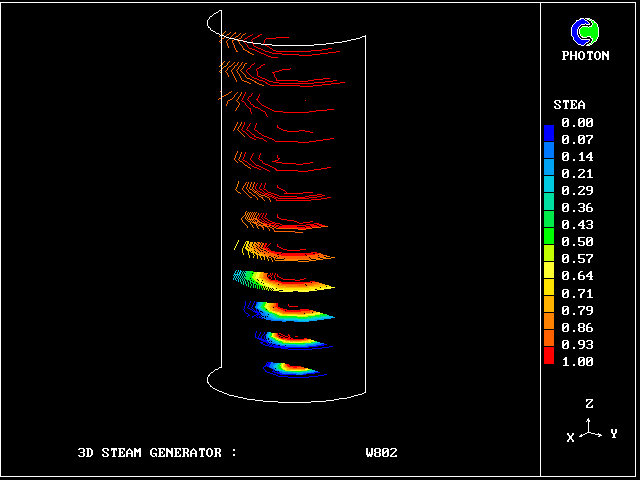
Contours of volume
fraction of steam,
formed from water
entering at the
bottom of the
cylindrical vessel
The steam-generation
pattern is not
symmetrical because
the temperature of
the water in the
immersed U-tubes
falls between inlet
and outlet.
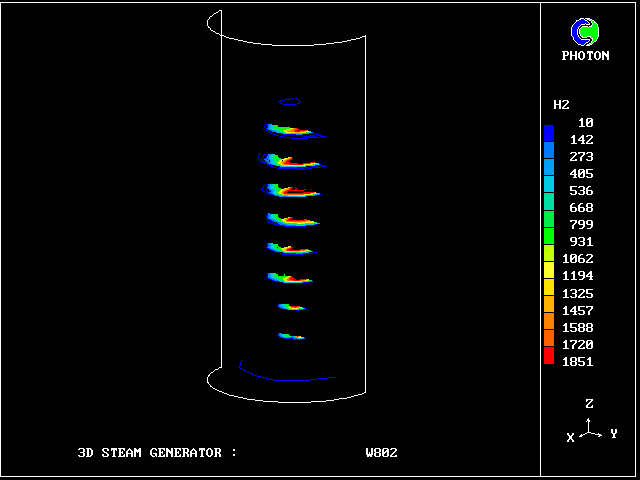
The water enthalpy,
measured above a
base value
corresponding
to the entry
temperature, just
below boiling point.
The water becomes
super-saturated
where the heating
rate is most intense.
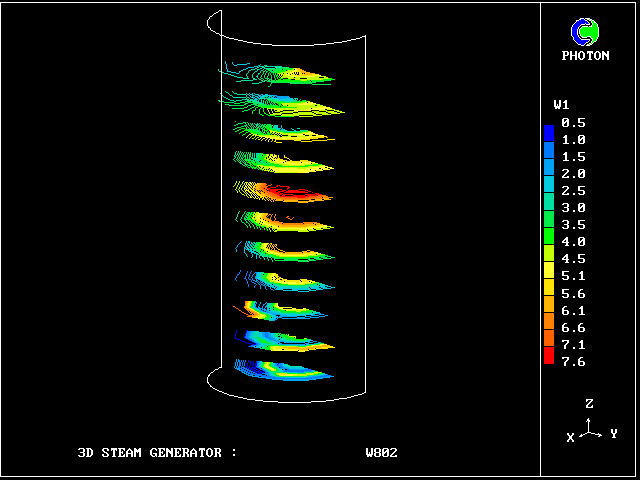
Contours of upward
velocity of steam.
The flow pattern is
far from being axi-
symmetrical.
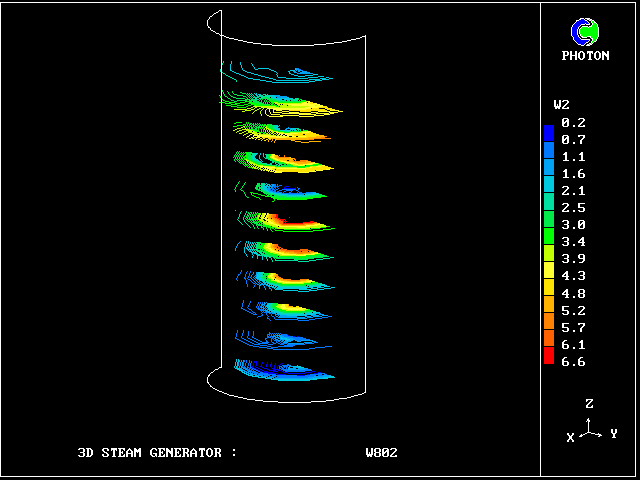
Contours of upward
velocity of water.
Note that the water
velocities are
smaller than the
steam velocities,
because of
inter-phase slip.
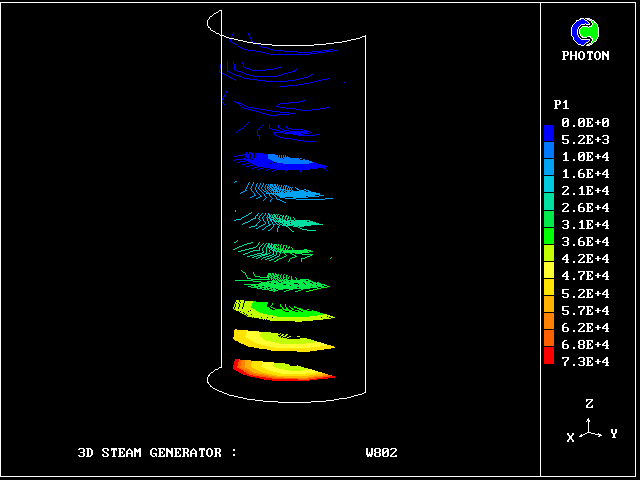
The distribution
of pressure.
The pressure
diminishes with
increase in height
partly because of
gravity and partly
to accelerate the
steam-water
mixture.
Another example: a coal-fired furnace
Library case C111; the Q1 file
The IPSA method is
used so as to
simulate the
different but
interacting
motions and exchanges of heat and mass between the
coal and the
burning gases.
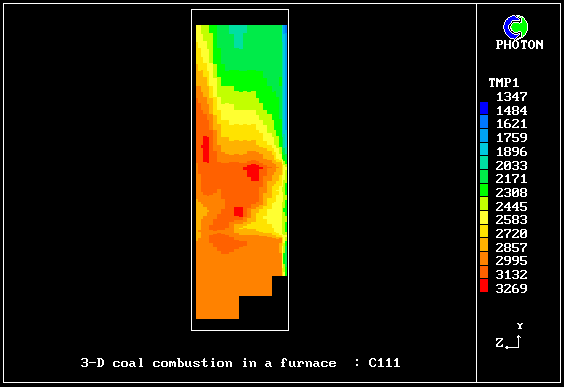
Gas-phase temperature contours
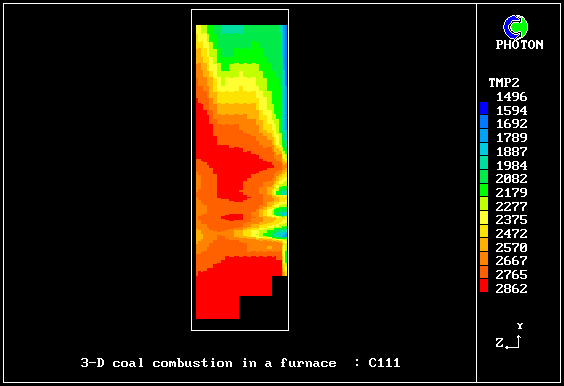
Solid-phase temperature contours in the coal-fired furnace.
Note that the gas and coal temperatures are not the same.